

On this page
Mobility — WiFi
Understand the WiFi solution, its spatial context, and the analysis views used to investigate measurements.
Mobility is the Lens solution for collecting and analyzing WiFi observations. It combines measurements from devices with the locations, spatial context, and WiFi infrastructure needed to interpret them.
Use this section to plan the solution and understand its evidence. Shared agents, programs, configurations, and deployments are explained in Lens Platform.
What belongs to Mobility
| Area | Purpose |
|---|---|
| Spatial model | Organize buildings, floors, floor plans, and areas within a location |
| WiFi infrastructure | Describe the networks and access points relevant to the site |
| Collection | Prepare devices and measurement settings for the observations you need |
| Analysis | Review a site’s results, investigate technical findings, and compare locations |
All 2.5D spatial management belongs here, including areas. A floor plan supplies context for observations; the presence of a plan does not establish that every part of it has been measured.
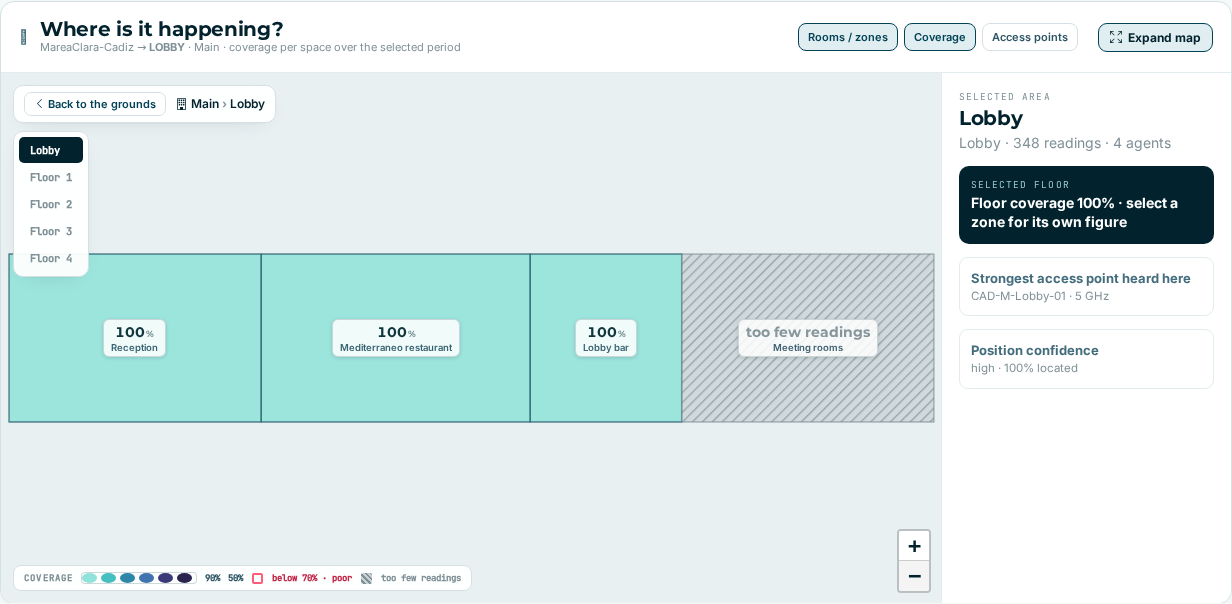
Choose an analysis view
| View | Use it to | Check before drawing a conclusion |
|---|---|---|
| Report | Read the site’s WiFi report | The location, period, and measurement availability |
| Pulse | Review current conditions and their spatial and time context | Whether the selected period contains representative observations |
| Diagnose | Investigate access points, technical findings, agent health, and time-of-day behavior | Whether missing or uneven collection could explain the finding |
| Compare & Act | Compare locations and identify where to investigate next | Whether the locations have comparable measurement coverage and periods |
Some installations include illustrative business-context panels. Sample ratings or return-on-investment figures are not measured outcomes. Occupancy and reviews are being developed as optional modules; their presence in a demonstration does not establish an active integration.
Plan the first collection
Define the question before selecting devices. A repeated observation in one place answers a different question from observations taken across several areas. Identify the locations and periods you need, the device capabilities required by the measurement program, and who will verify that data arrived.
Keep device reporting and network quality separate. If there are no observations for an area, investigate collection before interpreting that area as good or poor WiFi.
Mobility concepts
A WiFi finding needs context: where observations were made, when they were made, which devices contributed, and what was measured. Mobility brings these dimensions together.
Location and spatial context
A location is the site you investigate, such as a hotel. Within Mobility, buildings and floors organize its physical structure; floor plans provide a visual reference; areas identify spaces you want to distinguish during analysis.
Use stable names that an operator can relate to the site. Similar names across different floors should not lead a reader to assume that observations came from the same physical space. See the spatial model.
Network, access point, and observation
A WiFi network and an access point are different concepts. A network name can be visible through several access points. Investigating one access point therefore does not automatically describe every place where that network is available.
An observation records what a device measured at a particular time. Signal conditions, network reachability, and collection availability answer different questions. Good signal alone does not establish that an application or internet service was reachable.
Time and measurement availability
Start with the selected period and the observations available within it. A quiet chart can mean stable measurements, sparse measurements, or missing measurements; those interpretations have different operational consequences.
When comparing sites or periods, check whether the contributing devices and measured spaces changed. An apparent improvement can coincide with a change in where data was collected. Use the detailed evidence to decide whether the comparison supports the action you are considering.
Business context
Hotel occupancy describes demand at the property. Guest ratings describe reported experience. Neither is a direct count of connected devices, and neither establishes how many people were present in a particular area.
The planned occupancy and reviews modules add these distinct perspectives. A relationship between occupancy, ratings, and WiFi observations is a reason to investigate; it does not establish causation.