

On this page
Data estates and application estates
Distinguish data flows from application behavior, choose the supported source platform, and use the corresponding investigation vocabulary.
modernAIze supports two kinds of estate. A data estate is investigated through its sources, structures, transformations, and outputs. An application estate is investigated through its programs or services, calls, control flow, and data contracts.
An estate is the body of related software and definitions being assessed. It can span several source systems, while an individual project selects one source platform and a defined set of inputs.
Data estates
The supported data platforms are SAS, Qlik, Informatica PowerCenter, SAP BW, Teradata, and DataStage.
Begin with an output: a dataset, report, measure, or warehouse object. Follow the processing and source dependencies that produce it. Typical questions include:
- Which sources contribute to this output?
- Where are joins, filters, conversions, and aggregations applied?
- Which transformations share an input or an intermediate structure?
- What would need to move to reproduce the output elsewhere?
For monthly revenue, the investigation follows orders and exchange rates through conversion and aggregation. Structures and relationships explain the data path; source review establishes the rules along it.
Application estates
The supported application platforms are COBOL and webMethods.
Begin with a program, service, or business operation. Follow calls, branches, reusable routines, and the records or documents exchanged between them. Typical questions include:
- Which program or service starts the operation?
- Which other programs or services does it invoke?
- What conditions select a branch or handle a failure?
- Which record layouts or document definitions form the boundary?
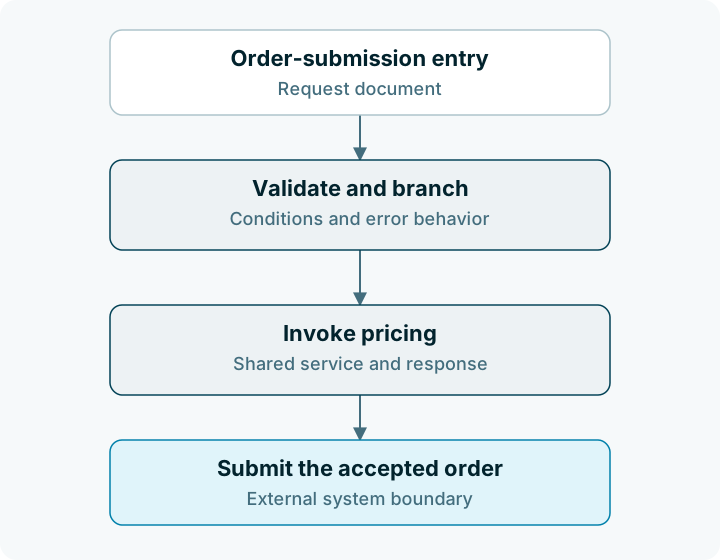
Consider a synthetic order-submission operation. An entry service validates the request, calls a shared pricing service, and passes an accepted order to another system. The assessment needs the call and error paths as well as the request and response structures. A data-flow diagram alone does not describe that operation.
What changes in the investigation
| Question | Data estate | Application estate |
|---|---|---|
| Starting point | Report, dataset, measure, or warehouse output | Program, service, transaction, or operation |
| Processing to inspect | Loads, mappings, transformations, calculations | Calls, routines, branches, loops, service steps |
| Structures to interpret | Tables, datasets, fields, source definitions | Records, copybooks, request and response documents |
| Important boundary | Upstream source or downstream consumer | Called program, invoked service, external operation |
| Candidate work package | Related processing around an output | Related behavior around an operation |
Briefing, Landscape, and Detail remain levels of investigation in both cases. Use the labels and system profile shown in the analysis; the profile can refine the perspective beyond the usual classification of the source technology. A COBOL program can process batch data, and an integration service can transform a payload while still requiring an application-oriented review.
Choose inputs by platform
Select the actual source technology when creating a project. Use its preparation guide to collect native source artifacts and their dependencies. Choosing an estate family is an architectural distinction, not an instruction to rename files or substitute a different platform in Setup.
See Supported source platforms for all eight platforms and the material each one accepts.